The methodology that connects strategic intent to working products—without the transformation theatre.
What NovaFraming Solves
Most organizations struggle with the same fundamental problem: brilliant strategy dies in delivery. Leadership defines compelling visions. Teams want to build great products. But between strategy and shipping lies a gap filled with misalignment, rework, and frustrated people asking “what are we actually building?”
Traditional approaches offer two unsatisfying paths:
Waterfall transformation programmes promise comprehensive planning but deliver eighteen-month roadmaps obsolete before implementation starts. Teams spend more time maintaining Gantt charts than shipping value.
Pure agile offers speed but struggles with coherence at scale. Individual teams sprint effectively while the organization fragments into dozens of disconnected products that don’t connect, don’t reuse, and don’t compound.
NovaFraming provides a third way: structured flexibility that enables teams to move fast while building toward coherent outcomes.
How NovaFraming Works
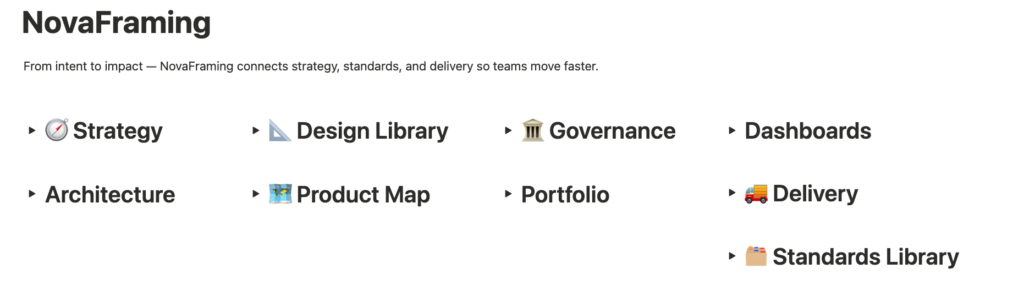
NovaFraming operates through four interconnected layers that create clarity from strategy through delivery:
1. Strategy Layer: Define Intent
Strategy without structure is wishful thinking. The Strategy Layer translates leadership vision into concrete, testable objectives:
- Strategic Thinking: The foundational “why” driving organizational action
- Strategic Themes: Major focus areas organizing investment and effort
- Vision & Value: The outcomes that matter and benefits that justify investment
- Problem Register: The real obstacles that are blocking the organisation from achieving their goals, or correctly their strategy
- Objectives & Outcomes: Measurable targets with defined success metrics
- Benefits & Metrics: How we know value is being realized
This isn’t strategic planning theatre. It’s creating the baseline against which all delivery decisions get tested: “Does this initiative move us toward our defined outcomes?”
2. Architecture Layer: Build Structural Understanding
Architecture isn’t ivory tower diagrams. It’s understanding what you’re building before you build it:
- Business Capabilities: What the organization must be able to do (not how it does it)
- Information Concepts: The entities and data that flow through capabilities
- Services & Enablers: Reusable building blocks that deliver capabilities
- Impediments Catalogue: Constraints that shape what’s possible
- Business Units & Roles: Who owns capabilities and who does the work
Architecture answers: “What are we building, and how does it fit together?” It creates the vocabulary and structure that let teams deliver independently while building toward coherence.
3. Design Library: Create Reusable Standards
The Design Library is where strategy and architecture become actionable patterns teams can use immediately:
- Data Model: Canonical definitions preventing “we have 47 customer definitions” chaos
- Integration Catalogue: How systems connect without bespoke point-to-point integration hell
- Solution Constraints: Guardrails that enable creativity within boundaries
- ADR Library: Architecture Decision Records capturing why choices were made
- Patterns Catalogue: Architectural Archetypes with their Instances and Variants—reusable templates that teams clone and adapt rather than rebuild from scratch
This is your organizational memory. Teams inherit decisions already made, patterns already proven, and integration already designed. They spend energy solving new problems, not rediscovering solved ones.
The Architectural Archetype Framework
At the core of the Patterns Catalogue sits the Architectural Archetype Framework—NovaFraming’s approach to building reusable, scalable architecture.
The framework operates at three levels:
Architectural Archetypes (Few, stable, enterprise-owned): Fundamental templates like Case Management, Charge Calculation, or Party Management that define structural patterns independent of business context.
Instances (More numerous, domain-owned): Business-specific applications of Archetypes—Customer Support Tickets as an instance of Case Management, Transaction Fees as an instance of Charge Calculation.
Variants (Many, operationally managed): Context-specific configurations of Instances—Technical Support vs Billing Support as variants of Customer Support Tickets, each with different SLAs and escalation rules.
This three-level structure enables three-speed delivery: Archetypes change rarely with high governance, Instances evolve over time with domain oversight, Variants adapt to what is happening on the ground with operational autonomy. Teams inherit proven patterns while retaining the flexibility to adapt to specific contexts.
The Architectural Archetype Framework solves the fundamental tension between standardization and flexibility: build once at the Archetype level, instantiate many times for business purposes, adapt endlessly through Variants.
Learn more about the Architectural Archetype Framework
4. Product Map: Translate to Deliverable Work
The Product Map bridges architecture to agile delivery using a four-layer testing model:
Epics: Planguage-style goals with quantified scales defining “good enough” vs “exceptional” For more details see Tom Gilb.
Features: BDD-linked behaviors that move Epic scales toward targets
User Stories: Concrete, testable scenarios delivering feature behaviors
Tests: Given/When/Then specifications tied directly to Outcomes + Metrics
Every item in the Product Map traces back through Architecture to Strategy. Teams always know: “Why are we building this?” and “How does success get measured?”
Supporting Structures: Governance, Portfolio, Delivery
Three additional layers ensure NovaFraming operates effectively at scale:
Governance: Decision rights, stakeholder engagement, deliverable traceability, and principles that guide choices when architecture doesn’t prescribe
Portfolio: Initiatives and projects organized by dependency and sequence, showing how work interconnects
Delivery: Sprint planning, project management, and test execution where actual building happens
Plus Dashboards tracking outcomes, benefits realization, and delivery performance—not activity theatre, but value delivered.
What Makes NovaFraming Different
Manual-First Philosophy
NovaFraming resists the temptation to automate prematurely. Initial work happens manually because manual processes force teams to understand before optimizing. Only after patterns stabilize does automation get introduced—preserving human judgment where it matters while removing repetitive toil.
This isn’t Luddite resistance to tooling. It’s recognition that automation of confusion creates consistent confusion. Manual-first ensures intent is clear before efficiency gets layered in.
Architecture as Platform, Not Police
NovaFraming architecture enables teams rather than controlling them. The Standards Library provides proven patterns teams can adopt. The Design Library offers integration blueprints teams can follow. But teams retain agency—they inherit wisdom, not mandates.
This creates governed autonomy: teams move fast within understood boundaries, making local decisions without organizational chaos.
Testing Through the Stack
NovaFraming connects tests to outcomes, not just features. Every test case links to:
- Stories it validates
- Features those stories deliver
- Epics those features advance
- Outcomes those Epics achieve
- Metrics proving outcome realization
This creates traceability from strategy to test result. When a test fails, teams immediately understand which strategic outcome is at risk.
Who NovaFraming Is For
Product Organizations Scaling Beyond Startup Chaos
You’ve proven product-market fit. Now you’re adding teams, and suddenly everyone’s building disconnected features. You need coherence without killing speed.
NovaFraming provides the structural clarity that lets teams deliver independently while building toward unified products.
Enterprises Escaping Waterfall Without Embracing Chaos
You’ve watched transformation programmes fail. You’ve seen agile become “do whatever without planning.” You need something between 18-month or 36-month roadmaps and sprint-by-sprint randomness.
NovaFraming offers just enough structure: clear strategy, defined architecture, autonomous delivery.
Platform Teams Enabling Business Teams
You’re building capabilities other teams will use. You need to define what you’re building, document how it works, and ensure teams can self-serve without constant support.
NovaFraming’s Standards Library and Design Library create the foundation platform teams need to scale their impact.
Architects Wanting Impact, Not Diagrams
You’re tired of producing architecture that teams ignore. You want architecture that ships—that actually changes what gets built.
NovaFraming makes architecture actionable: patterns teams adopt, standards teams follow, decisions that guide delivery.
What NovaFraming Delivers
For Leadership: Confidence that delivery aligns with strategy, with visible traceability from initiative to outcome
For Product Teams: Clear strategic context for delivery decisions without bureaucratic approval chains
For Architects: Frameworks that shape delivery rather than being ignored as “ivory tower thinking”
For Delivery Teams: Reusable patterns, clear integration paths, and autonomy within understood boundaries
For the Organization: Coherent products that compound value rather than fragment into disconnected tools
The NovaFraming Difference: Simplicity Beyond Complexity
NovaFraming emerges from a core principle: strip to fundamentals, then build systematically.
It doesn’t offer proprietary magic or consultingware requiring expensive interpretation. It provides structured thinking that organizations can adopt, adapt, and evolve as their context demands.
It’s architecture that ships. Strategy that delivers. Standards that teams actually use.
From intent to impact—NovaFraming connects the layers most methodologies leave disconnected.
NovaFraming © 2026 Charlotte Malmberg | Part of the systematic thinking framework collection at charlotte-malmberg.com
Want to know more, contact me on LinkedIn.